I asked Google and ChatGPT where to sell a painting in the North. Here's who they recommended, and what they got wrong.
Ask ChatGPT where to sell a painting in North Yorkshire, and you get a sensible shortlist – Tennants, Elstob, Morphets, Hutchinson Scott. David Duggleby isn't on it. They are a Scarborough saleroom with a Wikipedia page and a name among collectors for Staithes Group paintings.
Nobody at Duggleby made that call; rather, an AI did, based on what it could find.
I've worked in auction house marketing and understand the importance of creating a narrative people can trust and buy into. For years, you had the ability to control the first impression of a regional saleroom and shape it through the website, the catalogue, the local paper, the Google listing, etc. Increasingly, that first impression is a paragraph written by AI.
What's changed
Two things are happening right now. First, people are asking AI tools to recommend local businesses. In a spring 2026 survey, Yext found 38% of UK consumers had used one for local search in the past month.
Second, Google is writing its own summaries of businesses. Over September 2026, AI Overviews spread to most brand-name searches in the US. There is limited research on AI overviews for brand-name searches in the UK.
A business has the ability (for now) to claim and correct its knowledge panel when updates are needed (appears in the right column of a Google search). There's no equivalent for an AI Overview, which is uneditable.
The audit
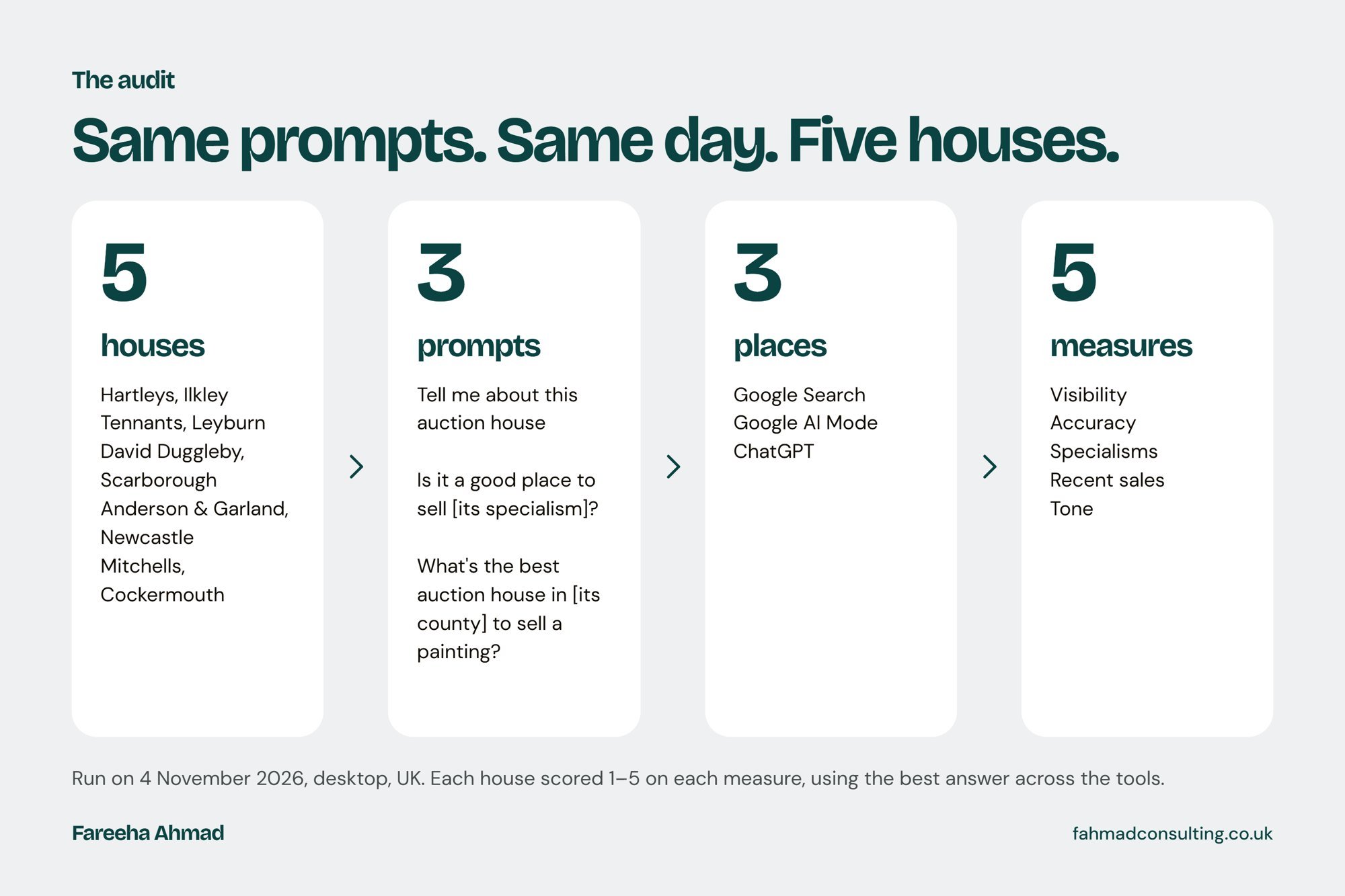
On 4 November I tested five well-regarded Northern houses: Hartleys in Ilkley, Tennants in Leyburn, David Duggleby in Scarborough, Anderson & Garland in Newcastle and Mitchells in Cockermouth.
I used Google Search, Google AI Mode and ChatGPT, with the same three prompts for every house:
Tell me about this auction house
Is it a good place to sell [its specialism]?
What's the best auction house in [its county] to sell a painting?
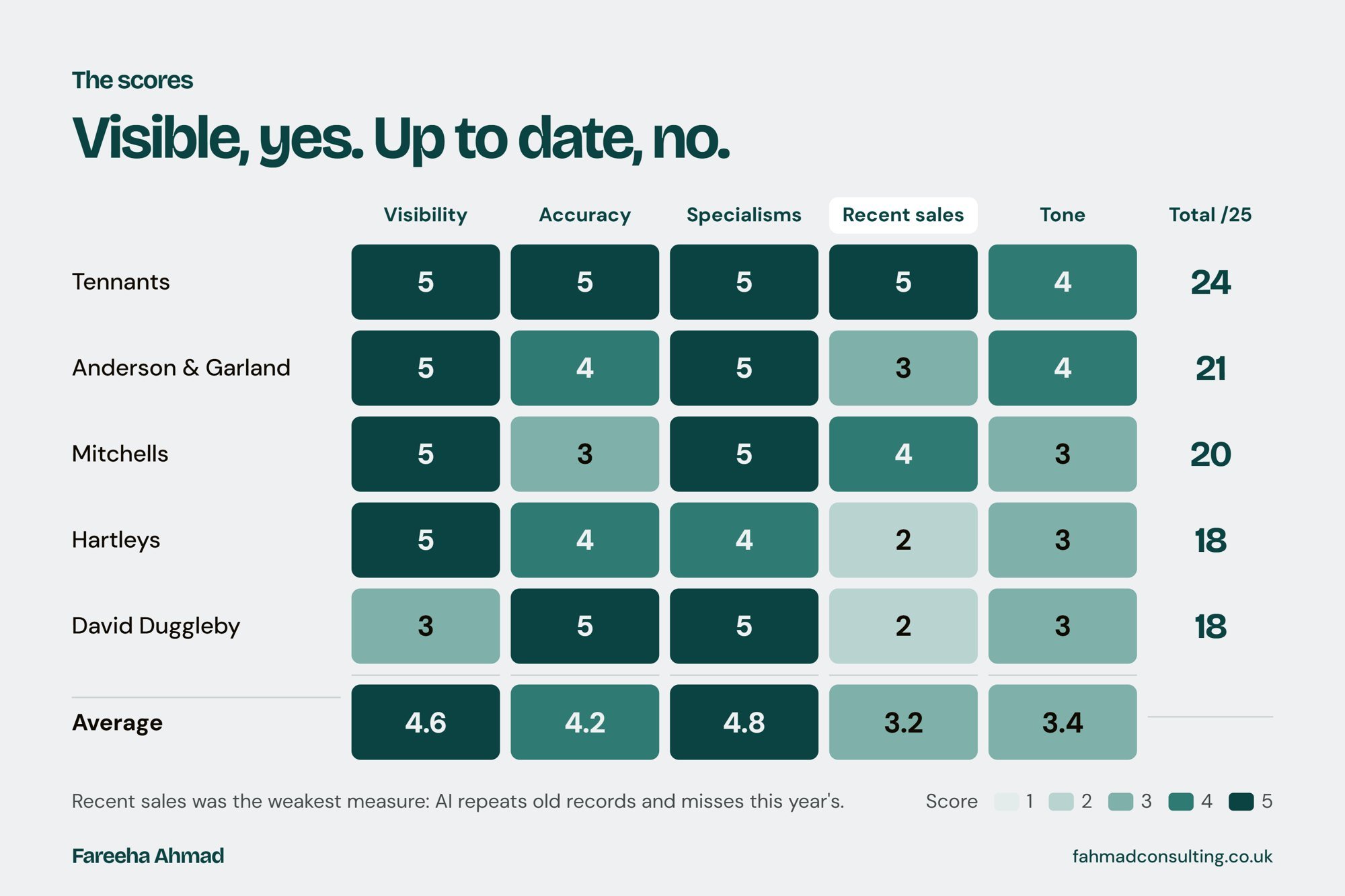
Then I scored each house out of five on visibility, accuracy, specialisms, recent sales and tone.
What I found
Firstly, all these houses are visible. AI Mode and ChatGPT both named four of the five first for their county. Tennants scored 24 out of 25, with answers that named its Mouseman department and its sales this year. The problems, however, lie in the detail.
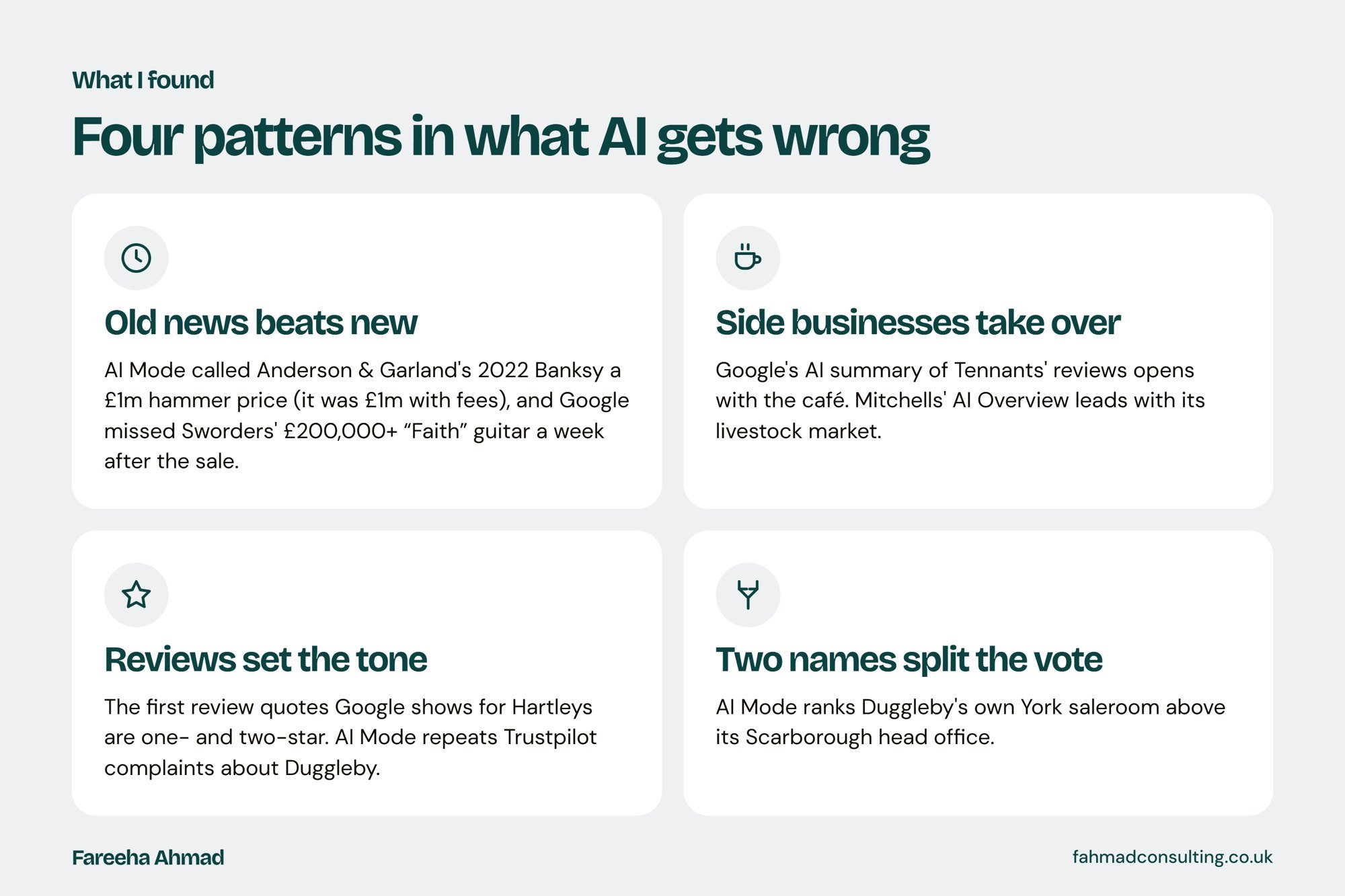
Old news beats new. Recent sales were the weakest measure, averaging 3.2 out of 5. AI Mode said Anderson & Garland's Banksy was hammered down at £1 million. It made £1 million including fees, and that was in 2022. A week after Sworders sold George Michael's "Faith" guitar for over £200,000, Google's AI Overview for the house didn't mention it.
Side businesses take over. Google's AI summary of Tennants' reviews opens with the café's sweet and savoury treats. Mitchells' AI Overview leads with its livestock market, and gives a different founding date from the one ChatGPT uses.
Reviews set the tone. Search "Hartleys auctions" and the first two review quotes Google shows are one and two-star. AI Mode's answer on selling through Duggleby repeats Trustpilot complaints about rejected valuations.
Two names split the vote. AI Mode ranks Duggleby's own York saleroom above its Scarborough head office.
The AI repeats whatever is easiest to find, so none of the data it is splurting out in searches is made up. Houses with a Wikipedia page, a clear FAQ and regular press came out best. That fits Ahrefs' research, which found Wikipedia cited in nearly three-quarters of the big-brand AI Overviews it checked.
Why it matters
Consigning a treasured collection or family heirloom is a considered decision. Vendors make every comparison they see fit before they pick up the phone. If an AI answer becomes the first shortlist, a house that's missing, or described by its café, starts on the back foot.
I couldn't find any research specifically on how UK vendors choose an auction house. It's clear what direction things are headed in, though. BrightLocal (US research) found the share of people using AI for local recommendations jumped from 6% to 45% in a year.
Five fixes any saleroom can make this month
Rewrite the first paragraph of your About page. Who you are, where, since when and what you're known for, in plain sentences.
Add an FAQ that asks "What is [house] known for?" Lyon & Turnbull has one, and Google's AI Overview repeats it almost word for word.
Publish every headline result as a dated news post. If it isn't written down, AI can't find it.
Keep your Google Business Profile up to date, and reply to reviews, especially recent ones.
Use the same name, founding date and facts everywhere: your site, Google, bidding platforms, and Wikipedia.
Google says there's no special trick to appearing in its AI features; they run on its normal search systems. So none of this guarantees what the AI will say. It just gives it better material to work with.
A caveat
This is a tiny snapshot of five houses, one day, one location and two AI tools. Answers can change from one search to the next. But the patterns were consistent enough to act on.
If you run a regional saleroom and want to know what AI is saying about yours, I'm offering a free one-page mini-audit to the first few houses that get in touch.
